
“Christmas” by Engelbert Humperdinck
Balázs Mikusi
Thursday, December 18, 2025
In the past two years our last news items presented musical greetings for the New Year: a tiny chorus by Carl Eberwein preserved in the collection of the Berlin Sing-Akademie, and a playful vocal bagatelle by Luigi Cherubini, apparently dedicated to his friend Alexandre-Charles Sauvageot, a famous collector of decorative bric-à-brac.
For a change, this year we would like to call your attention to a Christmas song composed by Engelbert Humperdinck (1854–1921). Humperdinck is arguably best known for his opera Hänsel and Gretel, which was first performed (incidentally, under Richard Strauss’s baton) on 23 December 1893 in the Weimar Court Theater and has remained a kind of ‘Christmas classic’ ever since, even though the libretto itself has no direct connection to the December feast. That said, the salvation of the hungry children through divine intervention (at least as told in the Grimm brothers’ version of the Hänsel und Gretel story), as well as the gingerbread (of which the witch’s cottage is built) certainly create a Christmas atmosphere. Furthermore, we happen to know that the whole idea of a full-scale opera on this topic grew out of a modest wish by Adelheid Wette (the composer’s sister) to have a few songs set to music for a small Hansel and Gretel play she planned to perform in a family circle. In fact, Adelheid is usually considered as the prime librettist of his brother’s opera Hänsel und Gretel overall, although the composer himself indicated that, in the course of expanding the original idea to a Singspiel and eventually a full-fledged opera, the libretto project gradually evolved into a larger-scale “family trouble” (Familienübel) with substantial contributions by Hermann Wette (Adelheid’s husband), Gustav Humperdinck (the composer’s father) and Engelbert himself.
But drawing inspiration from the literary experiments of his family was in fact characteristic of Humperdinck also in general. Many of his songs were set to texts offered to him by close relatives, among them also explicitly Christmas-related ones like “The Star of Betlehem” (Der Stern von Betlehem, EHWV 114), set on 9 December 1900 to a text by his wife Hedwig, or the “Little Christmas Song” (Weihnachts-Kinderliedchen, EHWV 113) written for the Christmas of 1899, once again to words by Adelheid. The piece laconically entitled “Christmas” (Weihnachten, EHWV 111) was composed yet a year earlier in Boppard am Rhein, and the autograph manuscript (RISM Catalog | RISM Online) is today kept in the direct neighborhood of its place of composition, in the Landesbibliothekszentrum Rheinland-Pfalz in Koblenz (digitized copy available here). The titlepage once again identifies the composer’s sister as author of the text, and calls attention to the optional chorus at the end, while after the closing bar we also find the exact date of composition: 7 December 1898.
In keeping with the style of Humperdincks’s second Lieder period (1898–1907), Weihnachten shows a clear tendency toward simpler melodies that evoke (to cite an aesthetic category promoted a century earlier by Johann Abraham Peter Schulz) the “appearance of the familiar” (Schein des Bekannten), as if the tune had been taken from a folksong (for a modern transcription of the autograph prepared by Christian Hesse click here). That the very beginning might remind some of “Where have all the flowers gone” is of course an illusion (since Pete Seeger’s anti-war song became a classic only in the 1960s), and while a connection to Friedrich Silcher’s well-known “Alle Jahre wieder” would be historically possible (for the incipit, see RISM Catalog or RISM Online), in this case the musical similarity is somewhat less striking. But the impression that, a mere few measures later, Humperdinck evokes the “Nimm’ sie hin denn, diese Lieder” phrase from Beethoven’s An die ferne Geliebte cycle to set the words “schlinget neue Liebesbande” could easily be more than an illusion, and indeed a conscious allusion, given that referencing this Beethoven melody had already had a long tradition e.g. in Robert Schumann’s works (most famously in his Symphony No. 2 and the Piano Fantasy Op. 17). Perhaps such references were common knowledge in the Humperdinck family and so a re-quotation of the quote could work as an inside joke? In any case, just as in Schumann’s case potential hints at his “distant beloved” (namely Clara) seem to make quite a bit of sense, Humperdinck’s embedding an intertextual ‘sidenote’ into a setting of his sister’s text that amounts to saying “Take them, then, these songs” may seem equally meaningful.
Although Humperdinck’s song is originally set for voice and piano, it inevitably makes a more festive impression if performed with orchestral accompaniment, especially if in the meantime we are also allowed an exclusive glimpse into the interior of Dresden’s famous Frauenkirche:
A tiny but noteworthy detail of Humperdinck’s setting is that, while the song’s phrase structure is essentially symmetrical, virtually the whole piece is notated as shifted by half a measure. Since at the beginning we hear the same motif three times (twice only in the accompaniment and then also in the vocal part), this off-beat character is not very pronounced – the overall impression is more that of floating, and in this regard no major change occurs through much of the song. To be sure, the music speeds up slightly for the second strophe (“Und schon hat mit tausend Sternen”), but the return to the starting tempo for the third strophe (“Lichte Himmelsboten”) still occurs at the middle of a bar (even if both the figuration of the accompaniment and the vocal melody offers a bit of variation). Thus, it is only the final vocal closure that brings resolution also in this metric regard, when the choral repetition of the soloist’s foregoing lines unexpectedly changes course: for the word “allen” Humperdinck inserts a halfmeasure (m. 62, notated as a full bar in 2/4), at the same time augmenting the rest of the cadence to fill a full 4/4 bar, and thus arriving with the final syllable “sein” on a downbeat – where the opening motif enters once again, at long last not off the beat. That this metric readjustment calls special attention to the change of words – for the soloist’s “Herzen” is here replaced by “Menschen” – only adds to the flourish, reminding every listener that, even if the composer might be giving an appearance of the familiar, he also keeps elaborate structural details in mind that go well beyond any proclaimed folksong aesthetic.
In conclusion it is worth mentioning that Humperdinck’s song has also achieved some popularity outside of Germany, in the English-speaking lands with a text by John Bernhoff that diverges rather far from Adelheid Wette’s original at several points:
1.
Hark! The herald host is singing,
Thro’ the silent holy night,
Tidings of great joy they’re bringing,
From yon starry azure height.
And each heart is filled with gladness,
At the message which they bring;
“Christ is born, forget all sadness,
Trust in Him, your Savior King!”
2.
And behold the stars bright glowing,
Shed o’er earth their radiant light,
While from Angels’ lips are flowing
Anthems thro’ the holy night.
Bright each window now is glowing,
Lighted by the Christmas tree;
And each cheek with joy is glowing,
And each heart is filled with glee.
3.
Soft the messengers from heaven
Wing their flight from home to home;
Bearing lessons God hath given
Unto all the earth that roam.
“Welcome, welcome Christmas evening
Bringing peace and love to earth!”
Show your gratitude, rejoicing,
Christians in your Savior’s birth!
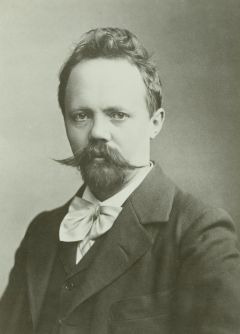
Image: Engelbert Humperdinck (1854-1921), Portrait via Deutsche Fotothek.
Share Tweet EmailCategory: Events
