
For the 150th anniversary of one of Mexico’s most prolific musicians
John G. Lazos
Thursday, July 9, 2026
Few musicians occupied as many roles in the musical life of 19th-century Mexico as José Antonio Gómez y Olguín (1805–1876). As composer, performer, pedagogue, editor, publisher, and cultural entrepreneur he belongs among the most influential figures of his time. The rediscovery and cataloging of Gómez’s surviving original sources have substantially expanded our understanding of an important period of Mexican musical culture, and have brought to light a repertoire that was largely unknown just a generation ago.
We begin with a portrait published in 1840, showing a well-dressed musician. It appeared as an illustration to a comprehensive biography – written in the third person and meant to introduce Gómez to the musical public of the Mexican capital. The metal engraving (rather uncommon in the region around that time) reflects his high social standing. The portrait presumably offers a close likeness of the young musician, and the emphasis on the details of his face and his clothing reinforces his socioeconomic status. Gómez was only 35 at the time.
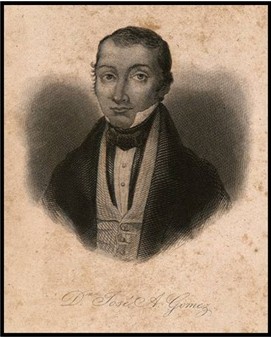
Portrait of José Antonio Gómez published in Mariano Galván’s Calendario de las señoritas megicanas para el año bisiesto de 1840 (Megico: Librería del Editor, 1840), exemplar at the Universidad Autónoma de Nuevo León with shelfmark AY19 .C3 1840 available online.
Born in Mexico City in 1805, Gómez began studying music with his father at an early age. Known as el niño Gómez (“Gómez the boy”), he gained recognition with both his keyboard skills and his voice; in particular as a singer he was called for in various churches. By the age of 10 he was already composing music and attracting the attention of diverse contemporary observers, who praised his precocious musical talent.
A notable experience was Gómez’s encounter with the celebrated Spanish tenor Manuel García, who had inspired the role of Almaviva in Rossini’s opera Il Barbiere di Siviglia. García’s visit to Mexico City exposed the young Gómez, then in his early 20s, to professional musical networks and performance practices that would influence his later career.
By the 1830s and especially the 1840s, Gómez had established himself as one of the most visible figures in Mexico City. His pioneering activities ranged from private instruction and concert performance to publishing projects designed for the educated circles of Mexico. Among the most notable are the following:
1832 Gramática Razonada Musical
Although largely adapted from Federico Moretti’s earlier treatise, Gómez’s work remains significant as one of the earliest Mexican music-theoretical publications to incorporate printed music examples, illustrating the growing role of print culture in the dissemination of musical knowledge. A copy of Gómez’s treatise is preserved in the Rare Book Collection of the University of Toronto.
1839 Prospecto y Reglamento de la Gran Sociedad Filarmónica y Conservatorio Mexicano de las Ciencias y Bellas Artes
This publication promoted Gómez’s ambitious conservatory project, reflecting his belief that music education was essential for the cultural advancement of the nation. Unfortunately, his own conservatory was short-lived.
1840 Gómez’s above-mentioned biography
1841 Variaciones sobre el tema del Jarabe Mejicano
A set of variations based on one of Mexico’s most popular traditional dances, the jarabe, which was subject to censorship by the Spanish Inquisition in the late 18th century. Its lyrics often conveyed explicit criticism of the authority of the church, making it a powerful symbol of resistance during the Mexican War of Independence. The world premiere recording of this virtuosic work can be accessed online.
1843 Instructor Filarmónico. Nuevo Método para piano
Just as with his previous pedagogical publication, the theoretical section of this treatise is not entirely original: Gómez drew upon the work of Josef Joaquín de Virués y Spínola (1770–1840), a Spanish music theorist. Nevertheless, the work reflects Gómez’s efforts to foster access to musical education through print culture. A digital copy is available in the Internet Archive.
1843 Instructor Filarmónico. Periódico Semanario Musical
While editing and publishing works by other composers was common practice in Europe, in Mexico Gómez’s efforts had a special significance. The first volume presents a colorful musical repertoire to a society that showed an increasing interest in domestic music-making after the war. With this publication in particular, Gómez contributed to the emergence of a cultivated musical environment extending beyond the traditional ecclesiastical and professional settings. In the Internet Archive one can also study this publication.
1844 Instructor Filarmónico continued
The second volume further expands the musical repertoire. Of the 35 works included in total, 13 are derived from operas, while the rest comprises 9 waltzes, 4 cuadrillas (a traditional Spanish dance), 3 songs, 2 sets of variations, 1 jota, 1 rondo, 1 overture, and 1 barcarole. The selection exemplifies Gómez’s efforts to strike a balance between European repertories, especially Italian opera, and works by Mexican composers.
| NATIONALITY | NUMBER OF WORKS | NAME | NUMBER OF WORKS |
| Italian | 13 | Donizetti, Gaetano | 7 |
| Mercadante, Saverio | 2 | ||
| Bellini, Vincenzo | 2 | ||
| Rico, Luigi | 1 | ||
| Bertini, Henri | 1 | ||
| Mexican | 12 | Gómez, José Antonio | 7 |
| Gómez, Alejandro | 2 | ||
| Baca, Luis | 1 | ||
| Patiño, Pablo | 1 | ||
| Covarrubias, Manuel | 1 | ||
| German | 2 | Strauss, Johann | 1 |
| Prixis, Peter | 1 | ||
| Spanish | 2 | García, Manuel | 1 |
| Cabrera, Paulina | 1 | ||
| French | 2 | Mussard, Philippe or Alfred? | 2 |
| Austrian | 1 | Herz, Henri | 1 |
| Of unknown origin | 3 | Lucrecia (?) | 1 |
| Name unknown | 2 |
1844 El Inspirador Permanente. Gran método de música vocal
Drawing on methods by Nicola Vaccai and Marco Bordogni, this treatise demonstrates Gómez’s continuing interest in vocal pedagogy and the spread of European teaching techniques across Mexico. A copy of this treatise can once again be found in the Internet Archive.
Collectively, these publications reveal how printed publications became an important instrument for shaping musical performance, education, and cultural identity in the decades following the successful War of Independence. Through pedagogical treatises, repertory collections, and educational initiatives, Gómez sought to broaden access to musical knowledge and strengthen musical culture in 19th-century Mexico.
And that is not all. Out of Gómez’s numerous sacred and secular compositions, we mention only two:
Pieza Histórica sobre la Independencia de La Nación Mexicana
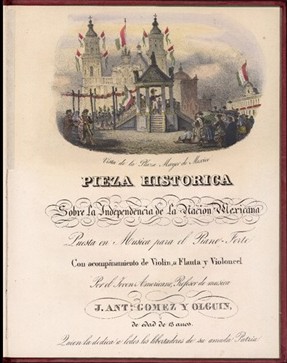
A programmatic work offering valuable insight into the role of music in the construction of national identity. Gómez transforms a political narrative into a series of 52 brief movements and a concluding hymn that represent Mexico’s struggles to become an independent nation. The only complete printed copy currently known survives as a set of four bound parts at the Real Biblioteca in Madrid, Spain. Particularly striking is the opening movement, which omits bar lines and employs a free piano texture to reflect the uncertainty and anticipation of its military protagonist. One open question is presented by the printing plate marked “C. H. ♮” – an abbreviation yet to be identified.
 |
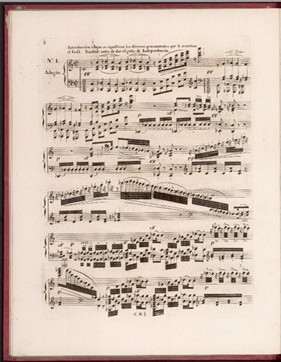 |
Title page and the first page with music from the piano part of Pieza Histórica by Gómez y Olguín. Courtesy Real Biblioteca del Palacio (E-Mp), shelfmark MUS/978.
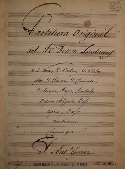
Partitura Originál | del Te Deum Laudamus | à 4, Voces, 2, Violines, 2, Violas, | oboé, 2, Flautas, 2, Clarinetes, | 2 Trompas, Fagot, Timbales, | Órgano obligado, Bajo | órgano y Bajo | continuo | Compuesto por | J. Ant.o Gómez. | En Mej.co Año de 1835.
The Te Deum illustrates Gomez’s ability to work under pressure on a large-scale ceremonial composition. He said that it had taken him “only two and a half days” to write this work to honor the President, who had been invited to the Mexico City Cathedral after winning a battle. The success of this work helped secure Gómez’s appointment to one of the principal musical positions at Mexico City’s Metropolitan Cathedral. It was performed again in a grand manner in 1840 for the ordination of the first Mexican archbishop – a solemn event described in detail in a 1842 letter by Calderon de la Barca, Frances Erskine Inglis Marchioness. This work has recently been revived also in a concert, providing modern audiences with a unique opportunity to listen to a major composition from Mexico’s early independent period.
One hundred and fifty years after his death, José Antonio Gómez y Olguín continues to emerge as a pivotal figure in 19th-century Mexican musical culture. His activities as composer, performer, pedagogue, editor, publisher, and institution leader contributed to the expansion of musical life in independent Mexico. Ongoing cataloguing, digitization, and dissemination of Gómez’s surviving works promise not only to shed light on the career of a remarkable musician, but also to enrich our understanding of Mexico’s musical past and its place within the broader history of 19th-century music.
Image on the top: Cover of the manuscript copy of Gómez’s Te Deum (1835), RISM ID 120000586 (RISM Catalog | RISM Online). Courtesy Archivo del Cabildo Catedral Metropolitano de México (MEX-Mc), shelfmark AM0843 [A-C]; A0825, available online.
Share Tweet EmailCategory: Musical anniversaries

