
The GND Editor and the Work Level in RISM
Alexander Faschon and Desiree Mayer
Friday, July 24, 2026

The following article was kindly provided by Alexander Faschon and Desiree Mayer. Both are employed at the Saxon State Library—Dresden State and University Library (SLUB), where they oversee musicological projects within the NFDI4Culture consortium.
Since early 2026, RISM’s cataloging software Muscat has offered a new feature: the GND Editor for creating work records in the German National Authority File. The result of a collaboration between the RISM Digital Center, the German National Library, and the NFDI4Culture consortium, the editor marks an important milestone for RISM on the path to integrating external authority data. The new tool allows users to create GND (Gemeinsame Normdatei) authority records for musical works directly from Muscat. The following sections outline the technical details of the GND Editor and situate it in the context of RISM’s current activities related to the work level.
Layout and Workflow
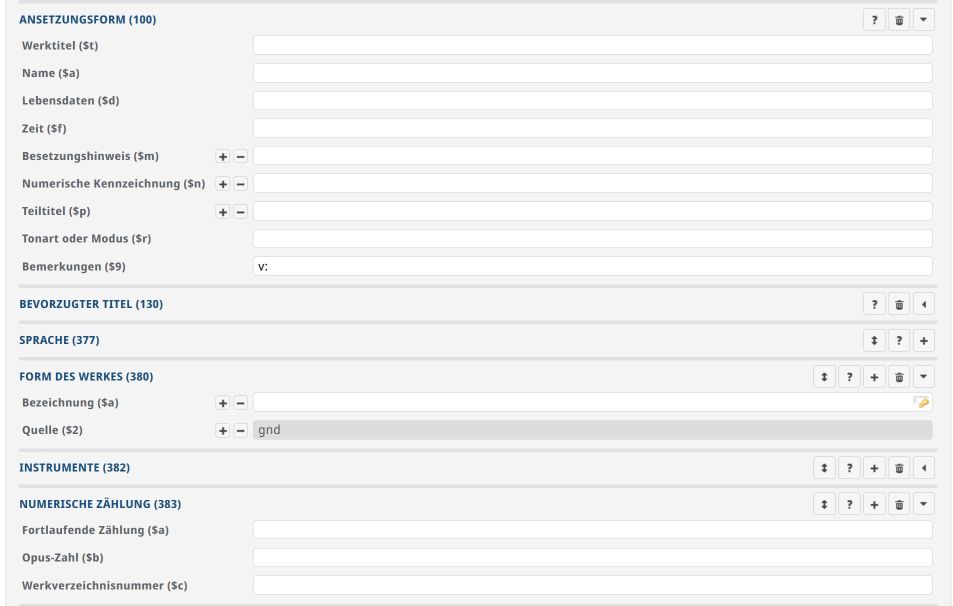
The GND Editor is fully integrated into Muscat: the layout of the data entry form looks familiar to experienced Muscat catalogers, allowing for easy use. On the other hand, the data structure corresponds to that of a GND work authority record; therefore, detailed help texts are available for each individual field. Write access is limited to musical works: persons or other entities of the GND cannot be created using this tool. For editorial and quality reasons, the editing of already existing records is only possible to a limited extent. To ensure the required data quality, users willing to use the new tool must first complete a training session introducing them to the editor, which is offered by the NFDI4Culture/SLUB Dresden team (Desiree Mayer and Alexander Faschon).
A prerequisite for creating a work authority record via the GND Editor is that the work does not already exist as a record in the GND. Once the data have been entered, the record is saved directly to the GND. If data fields are incomplete or do not comply with the rules, saving is not possible and a warning appears. Only after the correction of the error does the system allow for the saving of the work authority record. Upon successful saving, the record immediately receives a GND ID, which the cataloger can in turn reuse as a work node in Muscat (see below).
Such direct access to the GND is a unique feature and is of great relevance for the German-speaking musicological community. At the same time, the GND Editor is an important contribution to the newly created work level in RISM, which includes work nodes, works, and the potential to create catalogs of works via Muscat.
Work nodes
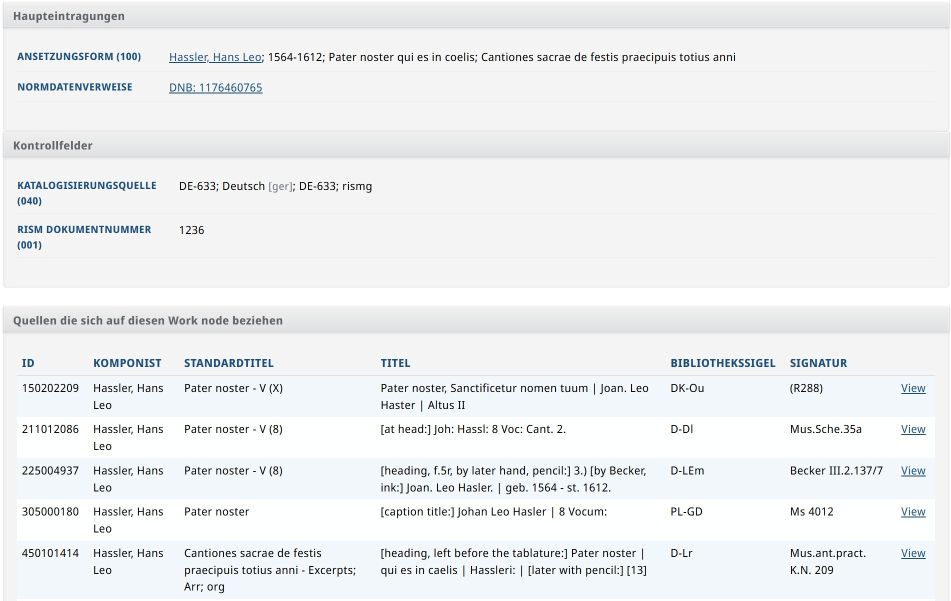
A work node is a record for a musical work in Muscat that serves as a hub for the sources associated with that work. A prerequisite for creating a work node is a corresponding work authority record in an external authority system (for all of the currently existing work nodes: in the GND), whose ID the work node carries as an external reference. Each work node represents the GND authority record for the musical composition in question in its basic form: work title (including subtitle or movement titles, if applicable), and the composer’s name accompanied by the dates of birth and death. This data is automatically retrieved from the GND when a work node is generated using a search function implemented in Muscat.
The function of a work node is to group under a single identifier all the RISM sources that represent the same work. Sources belonging to a work can be linked directly to the work node in Muscat using field 913. Sources linked to the work level can be queried via RISM Online by entering the GND ID through the “create a query” feature. The search results list all related sources.
Works
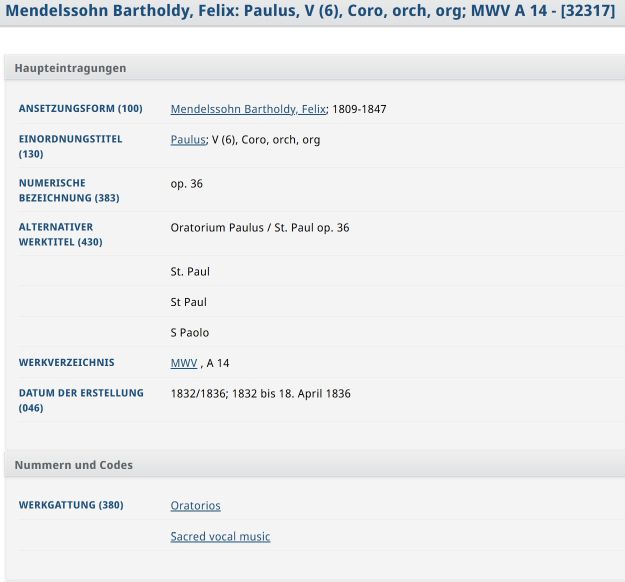
The other type of representation for works is based on work catalog entries in RISM’s source records. Just like work nodes, work records serve to group sources related to a particular work. However, they contain more information than work nodes. For example, they include music incipits for disambiguation, as well as comprehensive work information, and reflect the scholarly principles used for the structuring of the oeuvre in the respective catalog of works. A significant amount of the work records has been generated automatically from the corresponding source records before being checked and edited by hand.
While work records represent the canonical repertoire as reflected in existing thematic catalogs, work nodes offer the possibility to create nodes also for compositions that are neither widely known nor listed in a catalog of works. Work records are made available to users with RISM reference IDs for external use as well; work nodes, on the other hand, can only be referenced externally via the GND ID they include.
The implementation of the work level offers significant new opportunities for the analysis of RISM data, while also improving its interoperability: thanks to the inclusion of GND IDs, RISM becomes interoperable with other data hubs, such as the musiconn.performance repository, which also makes use of GND work authority IDs. An authority data ID is also essential for searching in higher-level systems – for example, the NFDI4Culture Knowledge Graph or other international LOD initiatives – as it allows information about works to be aggregated.
Overall, the work level significantly increases the data set’s potential for musicological research, among others in the fields of network, transfer, or reception studies. RISM thus keeps evolving: from a library reference system for sources toward a data hub.
Share Tweet EmailCategory: Electronic resources
