
Networks of Composers in RISM B/I Anthologies
Gabriele Taschetti and Daniel Zilio (University of Padua)
Thursday, October 8, 2026
The following text provides a short summary of the paper “The Early Modern Music Club. A Social Network Analysis of RISM B/I Anthologies” presented at this year’s MedRen conference (Warsaw University, 6–10 July 2026). The authors would like to thank the MedRen 2026 organizers for a cleverly assembled, well-moderated, and genuinely stimulating session, including an engaged Q&A, as well as the RISM Editorial Network for the interest in their work.
The history of music printing conventionally begins with an anthology. From Petrucci’s first publication in 1501 (RISM Online | RISM Catalog), the anthology – a single volume gathering works by multiple composers – was the dominant format for printed polyphony until around 1550, and remained a significant presence throughout the following century and a half. Whether or not they reflect genuine artistic collaboration or a shared musical milieu, these collections are meaningful historical compilations: they document what someone, in a given time and place, judged worthy of being put into print together, and they determined how that repertory circulated and was received across Europe. At MedRen Warsaw 2026, we presented preliminary results of an attempt to observe this at scale, mapping the networks of composers that emerge from these volumes.
We used the index published by Pietro Zappalà and others in 2005 (as well as later updates) as our ground truth: a curated index of composer attributions across the entire B/I series (deliberately excluding known reprints). RISM Online’s public API exposes the same material as linked open data, with composer attributions available for the large majority of the anthologies. We therefore cross-linked the names and editions in Zappalà’s index with identifiers and metadata from the RISM API, yielding full coverage of more than two thousand anthologies and over three thousand composers.
Applying a community detection algorithm based solely on composers’ co-presence within anthologies, we observed how the corpus divides into a set of distinct communities, some of which coexist and overlap in time. These emerge purely from patterns of shared appearance in print, and they broadly track the kind of groupings (by generation, region, or genre) that musicologists have already recognized through other means. That alignment is an encouraging sign that co-occurrence data captures something meaningful about how this repertory was built and circulated.
Within this modular structure, composers occupied very different positions. Claude de Sermisy and Pierre Certon, for instance, are central figures of the mid-century chanson repertory but nearly absent elsewhere. Orlando di Lasso is the opposite case. He ranks first in betweenness centrality, moving across several distinct communities – among them the Roman landscape and groups of composers from German-speaking regions – without ever becoming the central hub of any one of them. Giovanni Pierluigi da Palestrina, an equally emblematic figure of Renaissance music history (and historiography), is by comparison mostly confined to a single community, the Roman one, where he ranks below Luca Marenzio, Giovanni Maria Nanino, and Ruggiero Giovannelli by internal centrality. No composer in two centuries of printing combines both roles of local hub and cross-world connector.
The data also allow us to identify the most frequent pairings: Clemens non Papa and Thomas Crequillon, Pierre Certon and Claude de Sermisy, and Jacob Arcadelt and Certon. But recurring groups become equally visible: a small number of composers recur together across many anthologies, and the most frequent groups of three all turn out to be subsets of a single larger group – Felice Anerio, Giovannelli, Marenzio, Nanino, and Palestrina – appearing together in a considerable number of anthologies.
A further aspect concerns ‘local’ anthologies: collections whose composers appear nowhere else in the entire corpus. A number of anthologies fall into this category, such as the early Tudor XX Songs XX Songs (London, 1530) (RISM Online | RISM Catalog) and the collection Las ensaladas (Prague, 1581) (RISM Online | RISM Catalog).
API-enriched data, such as places of publication and composers’ life-dates, allowed for a comparison between appearances during a composer’s lifetime and posthumous ones. For most major composers, anthology appearances after death shifted overwhelmingly towards German-speaking lands. Interestingly, composers such as Lasso, Palestrina, Philippe de Monte, and Marenzio appeared in English anthologies only during their lifetimes, suggesting a different attitude in the German and English markets towards the contemporary repertoire.
The printed anthology may be one of the more tractable entry points for a large-scale, data-driven history of early modern music. This is work in progress, and we are now testing how far an approach based entirely on the RISM Online API can go. We would be happy to share the full study in due course.
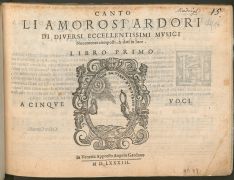
Image on top: Title page of an anthology: RISM B/I 158312: CANTO | LI AMOROSI ARDORI | DI DIVERSI ECCELLENTISSIMI MVSICI | Nouamente composti, & dati in luce. | LIBRO PRIMO | A CINQVE VOCI Venice, appresso Angelo Gardano, 1583; RISM-No. 993120720 (RISM Catalog | RISM Online) | Image rights: Bayerische Staatsbibliothek, Sign. 4 Mus.pr. 44#Beibd.14 | Public Domain Mark Universal 1.0
Share Tweet EmailCategory: Library collections
