
The Orpharion and its music
Thursday, September 3, 2026
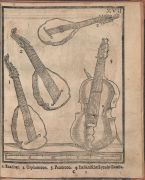
Today we would like to draw your attention to the orpharion, a plucked string instrument from the time of the Renaissance. Its name – which in Michael Praetorius’s Syntagma Musicum (Vol. 2, 1619, Plate XVII) appears as “Orpheoreon” – refers to two singers from Greek mythology: Orpheus, who enchanted both people and animals with his music, and the kitharode Arion of Lesbos, who was saved from drowning by a dolphin thanks to his artful singing.
With its flat back and wire strings, the orpharion belongs to the cittern family. Like the slightly larger and probably older bandora (or pandora), it has a distinctive shape due to its undulating, wave-like sides. The database of Musical Instruments Museum Online describes one of the few surviving original examples.
With its 7 to 9 courses, the orpharion can be tuned like a lute, and is thus capable of performing the extensive lute repertoire of the period around 1600. Nevertheless, the orpharion has a longer neck, a larger number of frets, and a range that extends higher than that of the lute. The considerable similarity between the orpharion, the lute, and the bandora regarding their repertoire and, to some extent, their playing technique is occasionally reflected on the title pages of tablature prints. The tablature book A New Booke of Tabliture printed in London in 1596 goes so far as to include separate instructions for playing the lute, the orpharion, and the bandora (RISM Online | RISM Catalog). Each set of instructions is preceded by its own title page depicting the respective instrument. Offering popular pieces by composers such as Francis Cutting, John Dowland, and Peter Philips, the orpharion repertoire of A New Booke of Tabliture was decidedly up to date.
By the late 17th century, the popularity of the orpharion was coming to an end, although it was still mentioned in music-historical treatises of the 18th and 19th centuries. In the early 20th century, interest in the orpharion was revived in the context of historical performance practice, as evidenced by several replicas surviving from that period.
In the RISM database (RISM Online | RISM Catalogue) one finds a few publications that explicitly mention the orpharion in their titles, providing an insight into its repertoire around 1600.
Image: Depiction of an “Orpheoreon” in: Michael Praetorius, Syntagma Musicum Bd. 2 (1619), no. XVII, Bayerische Staatsbibliothek 4 Mus.th. 1249-2,2 | Public Domain Mark | RISM B VI, Bd. 2, S. 666.
Share Tweet EmailCategory: Library collections
