
Joint Workshop of the Four "R-Projects" in Budapest
Thursday, September 24, 2026
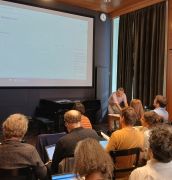
On 17–18 September 2026, Budapest was home to a workshop offering students of the Liszt Ferenc Academy of Music a chance to learn more about the four so-called ‘R-projects’: RISM, RILM, RIdIM, and RIPM. Each of the ‘Rs’ were set up several decades ago under the auspices of the International Musicological Society (IMS) and the International Association of Music Libraries, Archives and Documentation Centres (IAML), and each seeks to facilitate access to a special group of musical sources: RISM (the Répertoire International des Sources Musicales, founded in 1952) primarily to music manuscripts and printed editions, RILM (the Répertoire International de Littérature Musicale, founded in 1966) to writings about music, RIdIM (the Répertoire International de’Iconographie Musicale, founded in 1971) to visual sources pertaining to music, while RIPM (the Répertoire International de la Presse Musicale, founded in 1980) to music-related periodicals. Although every R-project organizes its work in a somewhat different way, they inevitably share many concerns as to the longer-term preservation of the music-related sources they deal with, as well as ambitious goals when it comes to making these available to an ever-greater community of users.
Focusing here on the two RISM sessions held Thursday morning, these were offered to an audience of over 40 people by the Executive Director of the RISM Editorial Network, Balázs Mikusi, and included both lecture-like and on-hand elements. Robert Eitner’s ten-volume Biographisch-Bibliographisches Quellen-Lexikon (1900–1904) was treated at some length as the direct model for RISM, which around 1950 was oftentimes simply referred to as “the new Eitner,” before receiving the French name we associate with it today. The friendly relationship between the German musicologist Friedrich Blume and the Russian-born music librarian of the Bibliothèque national de France, Vladimir Fédorov, proved also of great interest as one of the factors that made the foundation of both IAML and RISM possible at a time when international cooperation was an aspiration for many, but a rather thorny challenge to realize in practice. Mikusi also confided that the overall structure of RISM had never been easy to grasp, and in fact became even more complex after the recent restructuring, but he nonetheless made an effort to clarify how the different actors (as well as their names) have changed over time, so that the long-standing goals set by RISM’s founders could effectively be realized under the changing circumstances.
An overview of RISM’s numerous publications also gave a chance to look into the logic behind creating new institution sigla – one of RISM’s best-known features that also scholars otherwise invested in other research topics tend to rely on. Given the venue of the workshop, a brief historical survey of RISM activities in Hungary was also in order, showing all the ups and downs, but eventually concluding on a positive note thanks to the once again rather intensive cataloging activities of the past few years (about which we shall soon report in somewhat more detail also on the RISM website). Finally, as a highlight of the on-hand part of the workshop, both RISM Online and the RISM Catalog were presented in some detail, focusing on a few advanced features that could prove useful for specific research queries. The students were also encouraged to try their hands at actual RISM cataloging in the training environment of the Muscat application, seeking to describe first a single music manuscript and then a manuscript collection (including several compositions) according to RISM’s cataloging guidelines.
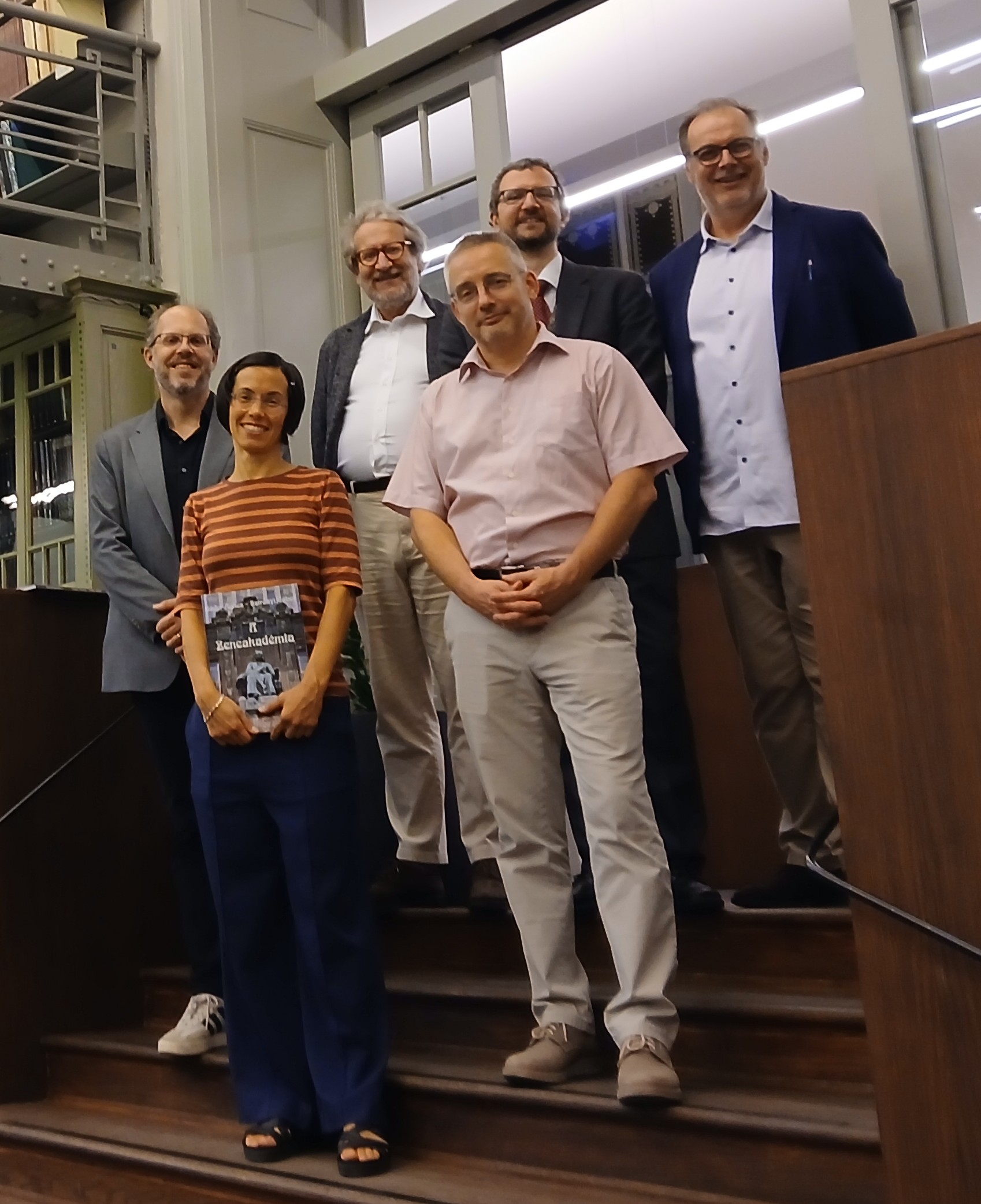
The workshop team (from left to right): Benjamin Knysak, Nicoletta Betta (both RIPM), Zdravko Blažeković (RILM), Balázs Mikusi (RISM), Ferenc János Szabó (Liszt Academy), Antonio Baldassare (RIdIM)
The other ‘Rs’ presented their work in similar length and depth, providing many new insights even to those familiar with their activities in general. Overall, the workshop proved a great success with the sizeable audience, hence we would like to thank the Director of the Library of the Liszt Academy, Ferenc János Szabó, for conceptualizing and organizing the event, as well as Lóránt Péteri as Head of the Musicology Department for accepting the workshop into the Academy’s curricular activities.
Image: Snapshot from the RISM workshop: How to catalog a music manuscript in Muscat (Photo credits: Ferenc János Szabó)
Share Tweet EmailCategory: Events
