
Church and Ballet Music from the Schwarzenberg Music Collection in Český Krumlov
Markéta Valíková
Thursday, November 12, 2026
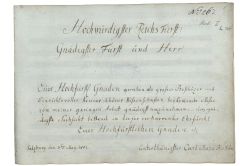
We have received the following from Markéta Valíková (The National Library of the Czech Republic, State Regional Archive in Třeboň).
The Český Krumlov Music Collection 1596–2000 is housed at the State Area Archive in Třeboň, the Český Krumlov Château branch (RISM library siglum: CZ-K; RISM Online | RISM Catalog). This involves one of the most remarkable music archive units in the territory of the Czech Republic or even in Central Europe. The collection is distinguished by its scope and age and by the representation of works by significant composers. It is divided into 26 sections of operas, oratorios, ballets, symphonies, theoretical works and sacred or piano music. This includes a series of composer manuscripts of Italian operas from the end of the 17th century, printed music from the end of the 16th and start of the 17th century and compositions dedicated to family members (for example, by Carl Maria Weber and Michael Haydn). The château collection amounts to a total of 7,087 items, including both manuscripts and printed music. It was created between the 17th and the 20th centuries, while most compositions date from the second half of the 18th century and the first half of the 19th century.
The basis of the collection consists of music acquired by Prince Joseph zu Schwarzenberg (1769–1833), which was purchased in 1821 after the death of his brother Ernst zu Schwarzenberg, the Bishop of Györ. Other items include music from the Schwarzenberg court ensemble, the château chapel or the estates of other members of the House of Schwarzenberg, especially that of the great music and dance lover Joseph Adam zu Schwarzenberg (1722–1782) and the diplomat and Austrian Federal Minister Felix zu Schwarzenberg (1800–1852). However, the precise origins of the other compositions in the collection remain unclear. The aforementioned bishop Ernst zu Schwarzenberg was especially responsible for the creation of the princely collection. He held concerts at his seat at Aigen Château near Salzburg, which he participated in as a singer, initiated the establishment of Salzburg’s aristocratic academy of music, which he chaired, and supported numerous talented artists. It is therefore no wonder that he received many dedications from grateful composers, especially from the ranks of the pupils and admirers of Michael Haydn. Ernst thus started to build up a significant music collection, of which a significant portion consisted of compositions inherited from his mother, Countess Eleonora Öttingen-Wallerstein. Ernst also attempted to compose his own works, which is borne out by his 18 composer manuscripts. Eventually, however, his costly lifestyle led him into financial difficulties and he was found to be owing 200 thousand florins after his death. The valuable music collection, which was supposed to have been sold as scrap paper, was purchased by Ernst’s brother Joseph von Schwarzenberg. The music was initially brought to the Schwarzenberg Palace in Vienna and then moved to the château in Český Krumlov prior to 1837.
Church music
The collection of sacred music was recatalogued for RISM, the International Inventory of Musical Sources (Répertoire International des Sources Musicales), in 2020. In total, it amounts to 369 works, which rank among the more extensive pieces and specifically accounts for the sixth most extensive category of the collection’s 26 sections. The church music was not arranged by type, author or even date of acquisition, but somewhat randomly. It comprises both printed music and manuscripts, whereby the manuscripts predominate by a third. From the point of view of the types of compositions, this involves church music that is designated for the liturgy, such as masses, litanies motets, hymns and so on. The composers most frequently come from the Viennese circle from the second half of the 18th century (Georg Reutter the younger, Johann Joseph Fux, Ferdinand Arbesser, Michael and Joseph Haydn and Wolfgang Amadeus Mozart), but a number of Czechs (for example, František Xaver Brixi, František Mensi, Jan Nepomuk Vitásek and Antonín Vranický) and Italians (Giovanni Battista Pergolesi, Leonardo Leo, Giovanni Felice Sances, Marc Antonio Ziani and Antonio Caldara) can also be found there. It is also possible to name the imperial Kapellmeister Antonio Bertali (1605–1669) and his representative Giovanni Felice Sances (1600–1679) from the earliest layer of the repertoire.
The orchestration of the individual compositions is not overly extensive and corresponds to the period standards for a small orchestra playing in a château chapel. The fact that the works were actually performed is indicated by the variants of the used texts.
Ballet music
The collection of ballet music was recatalogued for RISM in 2026. It comprises 183 manuscript works and, according to the Professor Helena Kazárová’s research, represents an extraordinarily extensive and cohesive collection of ballet music performed at the Viennese court theatres during the second half of the 18th century and the first quarter of the 19th century. The inventory lists, in chronological order, ballets staged by renowned ballet masters as Gasparo Angiolini, Jean-Georges Noverre and Franz Hilverding. It includes dance divertissements, comic ballets, ballets d’action with tragic themes, and choreodramas. The most frequently represented composers are Christoph Willibald Gluck (1714-1787), Franz Asplmayr (1721-1786) and Joseph Starzer (1726-1787). The ballets are scored for chamber orchestra, though the instrumentation was sometimes adapted for wind instruments. The location where these ballets were performed remains uncertain; possibilities include Český Krumlov or the Schwarzenberg Palace in Vienna. Some of the musical scores include the names of dancers, specifically soloists from Vienna. These names appear alongside individual musical numbers in ballets that premiered during the 1750s and early 1760s. Scores of Noverre’s famous ballets, however, do not list the dancers’ names.
Image: Carl Maria Weber: Missa solemnis, serie T, Státní oblastní archiv v Třeboni, pobočka Český Krumlov; Český Krumlov (Library-Siglum: CZ-K), shelfmark: 26D-I K I/ carton 345, RISM ID 1001000878 (RISM Online | RISM Catalog). Image courtesy of the author.
Share Tweet EmailCategory: Library collections
