
Franz Liszt's Donaueschingen Ländler
Wednesday, June 17, 2026
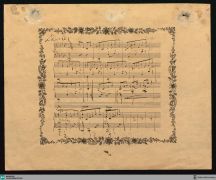
This text was inspired by a more comprehensive blog post by Wolfgang Seibold: “1843: Liszt in Karlsruhe,” published on the BLBlog on 11 March 2026.
In October 1843, after extensive concert tours in Switzerland, Italy, and especially France, the celebrated – though at times also demonized and caricatured – piano virtuoso and composer Franz Liszt embarked on a tour of southern Germany. His concerts were sold out, and the press effusively praised both his pianistic skills and the repertoire he played – mostly works by Liszt himself, although compositions by other composers, such as Ludwig van Beethoven or Carl Maria von Weber, were also performed.
On 23 November 1843, Liszt arrived in Donaueschingen, a residential city located on the edge of the Black Forest. The same day he hurried to pay a visit to the court and gave a short concert there “after tea.” A diary entry by the lady of the house, Amalie Christine zu Fürstenberg, records the works that Liszt performed on the evening of his arrival:
- Carl Maria von Weber, Aufforderung zum Tanze. Rondo Brillant in Des-Dur, op. 65
- Liszt, Fantaisie des motifs favoris de l’opéra La sonnambula (LW A56)
- Liszt, Ständchen (“Leise flehen meine Lieder”), Nr. 7 from “Schwanengesang” (LW A49)
- Liszt, Erlkönig, Nr. 4 of “Lieder von Schubert” (LW A42)
- “pleasant waltz from Ems” (which cannot be identified with any certainty)
On the side, the tenor Luigi Pantaleoni, who joined Liszt in his concerts several times, sang two Italian songs.
The following morning Liszt was busy rehearsing for a concert to be held in the evening at the palace. As was characteristic of the time, the program included a rather mixed repertoire of both original compositions and arrangements (virtuoso pieces, songs, as well as orchestral works), and was performed not only by the evening’s main attraction but also by several other musicians – such as the aforementioned tenor Pantaleoni, the Donaueschingen Court Orchestra, and individual members of the orchestra who played both solo and chamber music.
On November 25, Princess Amalie noted that Liszt had once again played “during tea time,” to which “a few people” had been invited. Furthermore, she made mention of a “Ländler” that Liszt had composed especially for her. In fact, the piece in question is only a few bars long. The princess kept the manuscript – a single sheet written on both sides – and through the Donaueschingen Fürstlich Fürstenbergische Hofbibliothek, this source eventually found its way to the Badische Landesbibliothek in Karlsruhe (RISM online | RISM Catalog). The Badische Landesbibliothek is making this precious trace of Liszt’s brief Donaueschingen sojourn available to the public in digital form. Incidentally, Liszt left the city early in the morning on November 26, headed for Karlsruhe, in pursuit of even more success.
Image: Franz Liszt, Ländler - Don Mus. Autogr. 39 : pf; A|b; RaaL 34 / Franz Liszt. (S.l.), 1843 (1843); source: Badische Landesbibliothek Karlsruhe, Don. Mus. Autogr. 39 https://nbn-resolving.org/urn:nbn:de:bsz:31-20486 | Public Domain Mark 1.0
Share Tweet EmailCatégorie: Collections de bibliothèques
