
Unknown music from Central and South America in the so-called 'Old Schott Archive' of the Mainz-based publishing house B. Schott's Söhne
Steffen Voss
Thursday, February 19, 2026
As part of the joint project “Cataloging, digitization and online presentation of the historical archive of the music publisher Schott,” in 2025 the Bavarian State Library completed the cataloging of the so-called “Old Schott Archive” in the RISM database. This task was carried out with funding by the German Research Foundation (Deutsche Forschungsgemeinschaft, DFG) and assisted by the Munich RISM working group.
The historical archive of the Schott-Verlag consists of approximately 4,000 individual musical works – manuscripts, printed editions (some in multiple copies), librettos, theoretical and instructional works – as well as related documents, covering the period from the late 18th century (i.e., the founding of the publishing house) to the end of the 20th century. The vast majority of the archive consists of manuscripts primarily submitted by their respective composers, which however were not accepted – or at best put ‘on hold’ – by the publisher (the correspondence preserved in the Schott business archive frequently reveals intriguing details in this regard). But there are also compositions printed by B. Schott’s Söhne on commission for other music dealers, publishers, or private individuals, which therefore formed no integral part of Schott’s publishing program. The wide geographical spread of clients is striking. B. Schott’s Söhne printed music not only for European customers from countries such as the Netherlands, Spain, Switzerland, Poland, Lithuania, Romania, Russia, and the Ottoman Empire, but it also had contacts in Latin America. The publishing archive contains various works by South American composers, often preserved in autograph manuscripts, which served as the engraver’s copy for an edition produced on a commission basis. As a rule, these autographs contain explicit instructions for the engraver with respect to the layout, as well as notes concerning the print run and the design of the title page.
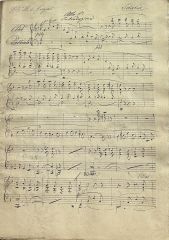
One of the important South American partners of B. Schott’s Söhne was the music dealer and publisher Manoel José da Costa e Silva from Belém, the capital of the Brazilian state of Parà. A great number of his original editions from the end of the 19th century are preserved in the “Fundo Vicente Salles” in the library of the Museum of the State University of Parà. For some of these editions, the manuscripts once sent to the engravers can now be found in the Old Schott Archive, including works by the German-born Alfred Baer (1853-1886), the Italian Enrico Bernardi (1838-1900), as well as a series of composers from Brazil: Henrique Eulálio Gurjão (1834-1885), Vicente Ruiz (1845-1892), Jerônimo de Sousa Queirós (1857-1936), Roberto de Barros (1861-1926) and Julia Cesarina Cordeiro (1867-1947). Of special interest is Enrico Bernardi’s complete piano transcription of Gurjão’s Italian opera Idalia (1881) (D-Mbs Mus.Schott.As 571, RISM ID Nr. 1001285919 - RISM Catalog | RISM Online).
Schott Verlag also had a remarkable partnership with the Chilean publishing house E. Niemeyer & Inghirami (Valparaìso), which not only maintained a representative office in Peru’s capital, Lima, but also had a branch in Hamburg, the port of which was frequented by many merchant ships from South America. This is how the autographs of five works by Claudio Rebagliati (1843–1909) also found their way to Mainz. Although born in Italy, at the age of 14 Rebagliati traveled with his father and his brothers – all of them musicians – to South America. Following an initial stay in Chile, from 1863 Rebagliati lived in Lima. According to a note penciled on the manuscript Mus.Schott.As 3085 (Il Carnevale di Venezia) from 1874, the shipping was arranged by the Chilean publishing house E. Niemeyer & Inghirami (Valparaìso) through their Hamburg office. Three of the five Rebagliati works sent to B. Schott’s Söhne were eventually published by Sonzogno in Milan; the reasons for the composer’s submitting these also to Schott remain obscure. By contrast, the two compositions for coloratura soprano and piano seem to have survived only in the Schott archive. The concert waltz Il suo sguardo Op. 11 (D-Mbs Mus.Schott.As 3087, RISM ID Nr. 1001319124 - RISM Catalog | RISM Online) is dedicated to the young soprano Teresa Ferreyra, who later became a well-known singing teacher at the conservatory in Lima. Newspapers reported that the virtuoso variations on the “Carnival of Venice” Op. 15 (D-Mbs Mus.Schott.As 3085, RISM ID Nr. 1001319082 - RISM Catalog | RISM Online) (for which no printed edition can be found, either) were sung in 1881 by the soprano Elvira Trepetto-Risolini as an insertion in the famous “singing lesson” scene of Rossini’s The Barber of Seville at the Vienna Court Opera. One way or another, the piece seems to have found its way back across the Atlantic Ocean to old Europe.
Image: D-Mbs, Mus.Schott.As 571: Henrique Eulálio Gurjão, opera “Idalia”, piano arrangement by E. Bernardi, beginning of act 1.
Share Tweet EmailCatégorie: Collections de bibliothèques
