
Made by Haydn?
Silke Schloen and Susanne Schrage
Thursday, January 15, 2026
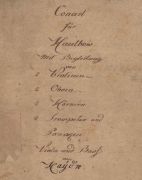
In their Studies on Works Falsely Attributed to Joseph Haydn the above question is raised by Prof. Dr. Arnold Jacobshagen (Cologne University of Music and Dance, Institute for Historical Musicology) as well as project collaborators Dr. Susanne Schrage, Silke Schloen, and Ioannis Tsiliakis. Researchers scrutinizing the sources of Haydn’s compositions have come across a vast number of misattributions. Common perceptions of the composer were colored by works in fact by other musicians, such as the string quartets “Op. 3,” the “Children’s Symphony,” or the six Feldpartien from which Johannes Brahms borrowed the melody for his “Variations on a Theme by Joseph Haydn” (in fact not the latter’s work at all). Haydn himself was well aware of the fact that many compositions were circulating under his name by mistake. In his preface to the Oeuvres complettes de Joseph Haydn, published by Breitkopf & Härtel in Leipzig between 1799 and 1806, he assured his readers: “nothing that has hitherto been unlawfully attributed to me will be included in this collection.”
The research project “Made by Haydn?” – approved by the Fritz Thyssen Foundation for three years (2023-2026) – examines the (according to our current estimate) approximately 1,300 works falsely attributed to Joseph Haydn. As part of the project, all available information on the misattributions is collected in a database, sorted by genre. This summary is based primarily on decades of preparatory work by the Joseph Haydn Institute in Cologne, where all works attributed to Haydn in a musical source or an old catalog have been registered. (Anthony van Hoboken followed a similar approach in his thematic catalog, distinguishing the non-authentic works from the genuine ones by placing a letter before the catalog number as an indication of the key signature.) In addition, information found in the RISM database and in library OPACs, as well as catalogs of works by other composers, are also taken into consideration. Examining every detail, the project seeks to identify the ‘mechanisms’ of the misattributions that occurred, as well as the areas where they tended to be most frequent, in particular their distribution across genres or geographical centers. The results will be made available in an online database set up in collaboration with the Digital Academy of the Academy of Sciences and Literature | Mainz.
By questioning the ‘authenticity’ of works attributed to Haydn and thus the historical and cultural mechanisms of inclusion and exclusion in the construction of musical authorship, the project draws on the philological methods of source criticism as established in musicology, and at the same time reflects how recent theories of cultural studies have distanced themselves from the idea of an ‘absolute’ concept of authorship. Complementing the author-centered editorial work carried out as part of the Haydn Complete Edition, the project brings to light a large number of previously unidentified authors and provides information about the conditions under which musical works of various genres and provenances were created, performed, and distributed.
Joseph Haydn is often cited as a prominent example by those willing to demonstrate that deliberately misattributing works to famous composers was a widespread practice in the 18th century. Nevertheless, empirical analysis of the data concerning instrumental works puts these figures into a broader context. In the case of symphonies, for example, the hypothesis that publishers sought to make the works of lesser-known composers more marketable by attributing them to the famous Haydn cannot be substantiated. The number of misattributed prints is in fact significantly lower than that of misattributed manuscript copies. Furthermore, the publishers of these prints were mainly based in Paris and London, two cities in which Haydn’s symphonies were indeed hugely successful, but both of which lay far from the composer’s places of activity, and were seen as major centers of music printing. Even so, with but a few exceptions, these publishers brought a large number of Joseph Haydn’s symphonies on the local market, among which relatively few works by other composers were mingled under his name. As for the manuscripts, international distribution via court and monastery libraries can be traced, and oftentime it is evident that several prints and manuscripts depend on a single misattribution. The number of misattributions is also put into perspective by the fact that many of them can be traced back to Haydn researchers of the 19th and 20th centuries, so they primarily provide historiographical evidence for a musicology obsessed with ‘great masters.’ A meticulous analysis of all relevant sources reveals a multifaceted picture that is no longer focused exclusively on Haydn, but rather provides complex insights into the interconnectedness of musical life and music publishing across Europe.
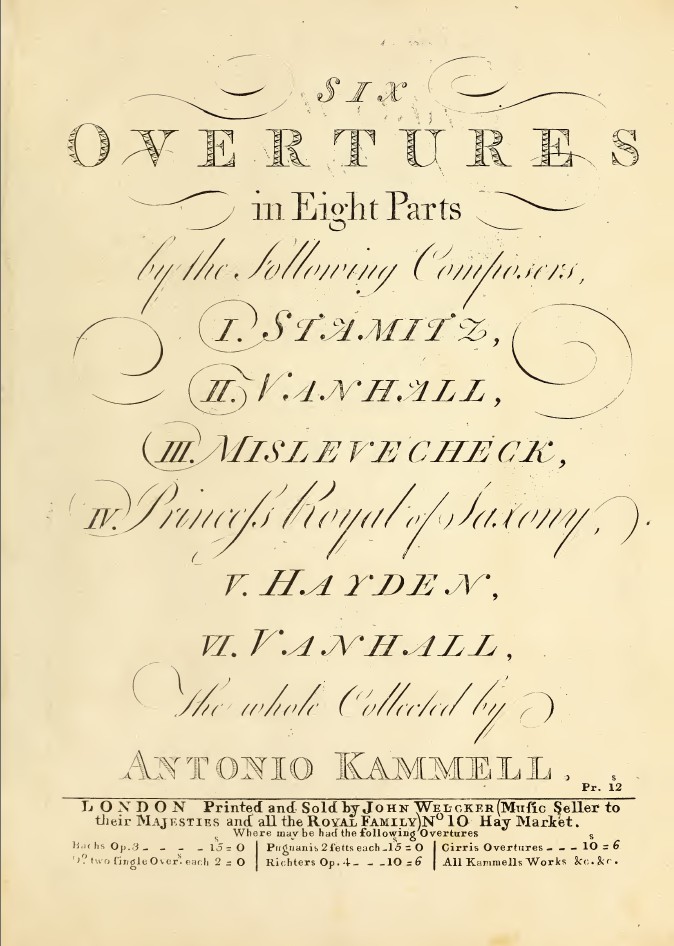
Title page of Welcker’s edition where the attributions to Haydn and Vanhal, respectively, are erroneously reversed (Symphony Hob. I:35 attributed to Vanhal, Symphony Hob. I:G9 / BryVa G8 to Haydn). Exemplar CDN-Lu (London, Ontario, Western University Library Canada, Music Library), Whitby Collection; Available online.
Our research project was first presented to the interested public in a book entitled Original and Fake? Controversial Authorship in Music and Art. The volume includes twelve scholarly articles which were originally presented as a series of lectures at Cologne’s University of Music and Dance during the summer semester of 2023. This format allowed for an intensive exchange with the related disciplines of art, literature, media, and legal studies regarding the significance of authorship and the manifold challenges encountered when seeking to identify authors.
Image (above): Excerpt from the title page of the concerto for oboe, Sächsische Landesbibliothek - Staats- und Universitätsbibliothek (SLUB), Dresden (D-Dl), Signatur Mus.3356-O-504, Available online, RISM ID no. 210097229 (RISM Catalog | RISM Online).
Share Tweet EmailCatégorie: A la une
