
Dealer's Stamps and Musical Scores
Patricia Puckett Sasser (Furman University)
Thursday, September 17, 2026
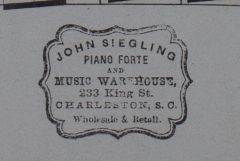
Dealers’ stamps (also called sellers’ stamps) have long allowed librarians, archivists, musicologists, and other researchers to trace the curation, consumption, and dissemination of musical scores. Some stamps provide detailed information, offering the name of the dealer, the location of the shop, and even the date of the sale. Others are much more obscure, containing only the seller’s initials or a stylized image, and require extensive detective work. Yet despite their importance to music scholarship, there are no dedicated reference sources for this research or any studies of the history and role of the stamp within the music trade specifically. As a result, non-specialists may confuse or conflate music dealer’s stamps with other markings, such as ex libris, royalty, censor, or copyist stamps.
This essay describes some preliminary efforts to identify and document music dealer’s stamps, drawing on examples from the nineteenth and early twentieth centuries. It explores the history of the stamp itself, its role in the music trade, and its significance within various contexts. Ultimately, it seeks to illuminate not just the stamp itself but also its place as both a source of information and as a form of musical iconography.
The Emergence of the Dealer’s Stamp
The music dealer’s stamp evolved from three earlier items: the ex libris stamp (which documented ownership), the booksellers’ label (which documented transactions) and the binders’ ticket (which, of course, documented binding). Ex libris stamps, composed in type but impressed by hand, appear as early as 1567. Labels and tickets can be traced back to the early 1700s although began to appear with greater frequency by the middle of the century. These small pieces of paper might be engraved, lithographed, or printed, often in rectangular, oval, or circular shapes on colored backgrounds. Tickets and labels would remain the dominant form of signature for musical scores until the beginning of the nineteenth century, when stamps began to supersede the older device.
Rubber stamps proved uniquely suitable to unbound scores for practical reasons. It was much easier to stamp a work rather than pasting a piece of paper (no matter how small) on another unbound piece of paper. Labels themselves could be awkward to handle, especially since most seem to have been produced in sheets and thus had to be trimmed down by hand to the correct size before being attached to the item in question. As Willman Spawn and Thomas Kinsella have noted: “the trimming of many tickets was noticeably careless. Circular tickets were seldom cut uniformly; squares were cut askew; octagons, especially with concave corners, called for more precision than was afforded. Many tickets were affixed in a haphazard manner as well. Presumably this menial task was left to apprentices and less-skilled workers.”[1] The stamp had the advantage of speed and simplicity in addition to a lower cost. Once it had been made, it might be used indefinitely although many sellers could and did commission new designs or devices over time.
Stamp Design
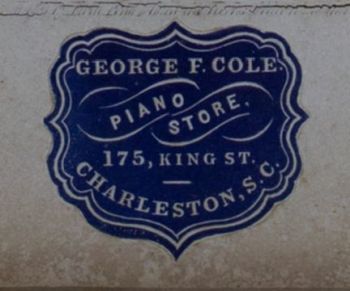
Early stamp design mirrored established ticket and label styles. These could vary drastically in size, from very small to very large. They also varied in complexity; some tickets and labels used only one typeface while others had multiple typefaces, elaborate borders, and brown, red, gold, blue, or black inks. Compare, for instance, a label from the George F. Cole Piano Store in Charleston, South Carolina with a stamp made for George Milbus’ Musical Depot in Washington, DC [Example A]. Clearly, the stamp was intended to mimic a printed booksellers’ label. Stamps soon abandoned the colorful backgrounds associated with tickets and labels, focusing instead on informative designs which conveyed the name and the location of the shop.
 |
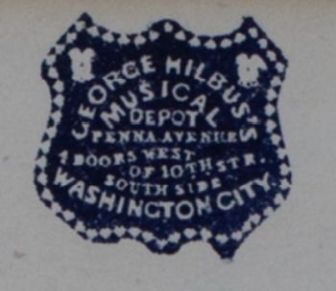 |
Example A: Bookseller’s label (left) and dealers’ stamp (right). Used by permission of the Sigal Music Museum (Greenville, South Carolina, USA)
By the second half of the nineteenth century, rubber stamp manufacturers regularly advertised their products in trade magazines. Many advertisements invited sellers to send away for specimen books, which displayed both available devices and the ways in which a given device could be customized for an individual music shop. Surviving specimen books reveal the wide range of variants on offer in addition to the fully bespoke stamps which could be obtained at a higher cost. Music dealers naturally changed their addresses, their locations, and their partnerships over time; the specimen books responded to the desire and need for new or updated stamps.
Roles of the Dealers’ Stamp
What can design reveal about the functions of the music dealers’ stamp? First and foremost, the stamp clearly served to promote the shop where the music had been purchased. Given the social roles of popular music, dealers knew that this music would likely be seen, handled, and performed by individuals beyond the original customer. The stamp offered a permanent reminder of the place where a particular score could be obtained and the purchaser helped to circulate that information through both private and public performances. The presence of street addresses and later telephone numbers on the stamps underscores their role in attracting new customers.
Some shops seemed to have employed stamps as a record of transaction. Although dated stamps appear much less frequently on surviving sheet music, it is clear that certain dealers did use the stamp to mark either the date of acquisition or the date of sale. Presumably these stamps allowed sellers to trace the movement of inventory into or out of the shop. Such stamps may also have allowed shops to distinguish between scores that had been sold outright and “music lent to copy,” an earlier business practice that was rapidly disappearing by the middle of the nineteenth century but which persisted in some places. It may also have reflected the fact that few customers paid for their purchases at the time of sale; most shops calculated a total at the end of the month (or other predetermined period) and sent a single bill.[2]
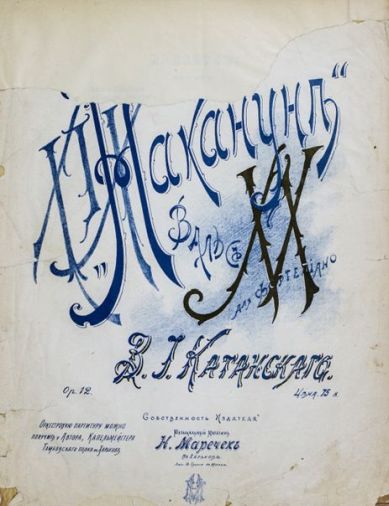
While these stamps foreground the complex and ever-evolving world of the music trade, other stamps appear to aim instead for simplicity (if not obscurity). Some stamps frequently adopt a stylized monogram or an icon, images that as striking as they are mysterious. Consider, for example, this score by the composer V.I. Katanskiĭ, Nakanuni͡e, published in Kharkiv, Ukraine in the early twentieth century [Example B]. The stamp at the bottom of the title page consists of an intertwined “N” and “M,” which offers very little information about the dealer at first glance—unless one considers the publication information just above the stamp: “N. Mareček.” The Mareček business had been founded in the 1870s by a Czech expatriate named Viktor Mareček; after Mareček’s death in 1899, his wife Nadiya Chenska continued to run both the publishing house and a music shop under the name of “N. Mareček” until her own death in 1910. The imprint and the stamp together establish not only the provenance of this work but also suggest that it was both printed and sold during the period when Chenska managed the music business herself.
 |
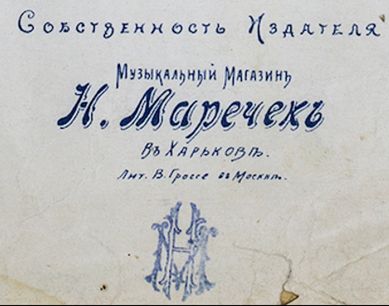 |
Example B: V. I. Katanskiĭ: Nakanuni͡e. Detail of the dealer’s stamp (right). Used by permission of Furman University Libraries (Greenville, South Carolina, USA).
Researching the Dealers’ Stamp
Although dealers’ stamps occasionally appear in various provenance databases, newspapers, almanacs, and directories serve as some of the best sources for conclusively identifying and tracing the music sellers associated with the stamps. One privately bound collection of nineteenth-century French art songs contains works from nine separate dealers and the fortunes of all nine may be traced through the annual Parisian Almanach du commerce. Simon Richault, one of these dealers, enjoyed a long and highly successful career despite the fact that the surviving stamps in question are now difficult to read and decipher [Example C]. In 1860, the Almanach records Richault’s music shop sharing premises with a lawyer, a dressmaker, a corsetmaker, and a dentist (among others). By 1871, Richault had moved eastward to the Boulevard des Italiens, a location closer to Charles Garnier’s new opera house, then under construction. By 1888, Richault’s listing had expanded to include the date of the founding (1805), the wide range of genres and instrumentation offered, and the services that the shop could provide. The Almanach also charts the gradual decline of Richault; in 1897, following the death of Simon Richault’s son, “Richault mére” began managing the business (given the date, this must have been a second or even third wife). By 1900, she had sold the stock to the Costallat firm and closed the shop.
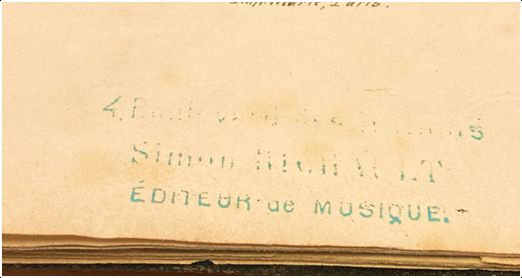
Example C: Stamp of Simon Richault (Paris, France). Used by permission of the Furman University Libraries (Greenville, South Carolina, USA).
Such sources can also prove especially helpful when the information on the stamp, the established provenance of the music, and the history of the dealer itself appear to contradict each other. These two stamps appear within a bound volume of scores collected by a Russian-speaking émigré living in the city of Harbin, China [Example D]. Lyra was a large and well-known music store located in Ukraine; Carl Fischer, of course, is headquartered in the United States. Although it seemed plausible that the collector might have brought the Lyra score to Harbin, the Fischer score seemed less likely. Further investigation revealed a second Lyra stamp, this one with a Harbin address. A Harbin city directory from 1926 clarified that both shops did, in fact, exist in the city. The Lyra shop may or may not have been officially associated with its Ukrainian counterpart (the double stamping suggests that the music was being re-sold) but the Carl Fischer store clearly operated as a branch location and thus made use of the English-language stamp.

Example D: Lyra (Harbin, China). Used by permission of the Furman University Libraries (Greenville, South Carolina, USA).
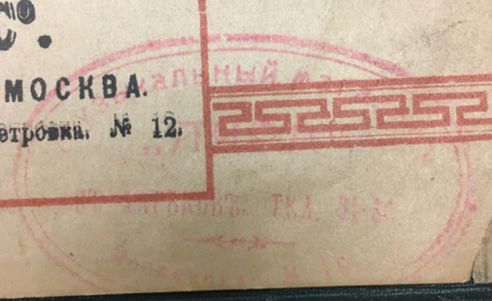
Lyra (Kharkiv, Ukraine). Used by permission of the Furman University Libraries (Greenville, South Carolina, USA).
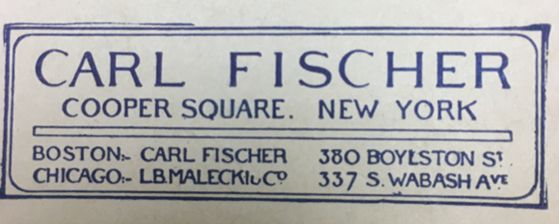
Carl Fischer (Harbin, China). Used by permission of the Furman University Libraries (Greenville, South Carolina, USA).
The Dealers’ Stamp as Musical Iconography
Any analysis of a musical image must account for the ways in which it reflects “a manifestation of the artist’s personality, the patron’s ambitions and the onlooker’s expectations.”[3] Although dealers’ stamps provide practical information, they also invite reflection on the artists (now mostly unknown) who produced the designs, the shops who selected and paid for the images, and the consumers who encountered them on their musical scores. The creative arrangement of text and devices suggests that music dealers were conscious and active in shaping their own identities even as they demonstrate a stamp’s ability to respond to a larger cultural context.
When a dealer added a stamp to the musical score, they did not merely add to the visual information present on the page. They linked the individual score to a particular place and period, to the history of a shop and its dealings, and to a unique artistic milieu. As a result, the stamps can do much more than to identify and date sheet music (although they often can do that). Stamps foster a fuller understanding of the music trade and offer insight into the specific ways in which sheet music was marketed and consumed. Perhaps most importantly, dealers’ stamps make it possible to envision the social and commercial lives of the exact scores in question and the various paths of transmission through which these scores moved as both aural and visual artifacts.
Notes:
[1] Willman Spawn and Thomas Kinsella, Ticketed Bookbindings from Nineteenth-Century Britain (Oak Knoll Press, 1999), 12.
[2] Floris Meens and Björn Spekschoor, “Shopping Sounds: The Rahrs’ Dutch Music Shop, Its Customers, and Their Tastes, ca. 1835–1900,” Journal of the American Musicological Society 78, no. 2 (2025): 411.
[3] Tilman Seebass, “Iconography,” Grove Music Online (2001).
Image on the top: Dealers’ Stamp of John Siegling, Charleston, SC. Used by permission of the Sigal Music Museum (Greenville, SC).
Share Tweet EmailCatégorie: Collections de bibliothèques
